Best 4-Way Articulating Borescope: Top 9 Picks (November 2026)
The best 4-way articulating borescopes include the Teslong Articulating Borescope for Mechanic Automotive HVAC for most inspections, the Acoath Two-Way Articulating Borescope for dual-lens viewing, and the VEVOR 4-Way Articulating Endoscope with Light for true 4-way control.
On this page (9 sections)
- The best articulating borescopes for each inspection need
- How do these borescopes compare?
- Does four-way articulation matter for your inspection?
- What probe size should you choose?
- Is a dual-lens borescope better than a single-lens model?
- Which screen and lighting features help most?
- How much battery life do you need?
- What should you record during an inspection?
- Verdict: which is the best 4-way articulating borescope?
The best 4-way articulating borescope for most people is the Teslong Articulating Borescope for Mechanic Automotive HVAC. It has a 5 ft semi-rigid cable, a 4.5 in IPS screen, built-in adjustable lighting and a central joystick, so it covers common automotive, HVAC, wall and household inspection work with simple handheld control.
The main decision is not just the number of articulation directions. A true 4-way scope gives broader steering, while a two-way dual-lens model can show forward and side views without turning the probe.
Probe diameter, screen size, battery life and documentation features matter just as much.
For HVAC work, compare the probe size and cable control with our guide to the best borescope for HVAC checks. If you are comparing tool brands, our Klein borescope guide and Klein ET17 vs ET19 comparison cover a different group of inspection options.
Our picks at a glance
-
1
 Best for most inspections
Teslong Articulating Borescope for Mechanic Automotive HVAC
9.6/10 our score
See it on Amazon -
2
-
3
 Best for true 4-way control
VEVOR 4-Way Articulating Endoscope with Light
9.4/10 our score
See it on Amazon
- 4
 Check it
Ralcam 4-Way 360° Articulating Borescope for Mechanic
Best for slim HVAC access - 5
 Check it
Ralcam M5 Series 4-Way Articulating Borescope
Best for replaceable probe tubes - 6
 Check it
VEVOR Articulating Borescope with 0.15" Slim Lens
Best for ultra-narrow spaces - 7
 Check it
DXZtoz Dual-Lens Articulating Borescope
Best for engine inspections - 8
 Check it
Zorlet 4-Way Articulating Borescope
Best for long recording sessions - 9
 Check it
Teslong Dual-Lens 4-Way Articulating Borescope
Best for documented findings
The best articulating borescopes for each inspection need
The Teslong Articulating Borescope is the best overall pick because it balances screen, lighting, cable length and handheld controls. VEVOR is the better fit for true four-way steering, while the other picks target narrow access, dual-lens viewing, replaceable probes or longer recording.
We compared the stated articulation, probe size, cable length, screen, lighting, storage, battery details and included accessories.
Teslong Articulating Borescope for Mechanic Automotive HVAC: Best for most inspections
- Two-way 210° articulation
- 5 ft semi-rigid gooseneck cable
- 4.5 in IPS color screen
- 32GB Micro SD card
A balanced handheld scope for automotive, HVAC, wall and household inspections. Its semi-rigid cable, built-in lights and no-app screen make it a practical first choice.
Pros
- One-handed joystick control
- 5-hour battery average life
- 32GB Micro SD card and carrying case
Cons
- Two-way articulation instead of four-way
- 3.1 lb item weight
Teslong is the strongest overall choice for general inspection work. Its 5 ft semi-rigid gooseneck cable bends through tight spaces while holding its shape, giving you more control than a loose cable during a wall, HVAC or automotive check.
The 4.5 in IPS color screen shows the camera view without requiring an app, internet connection or personal phone. The camera has built-in high-brightness LED lights with adjustable illumination, which helps when the inspection point is dark.
This model uses two-way 210° articulation rather than four-way steering. That is the main trade-off against the VEVOR and Ralcam four-way picks, but the central joystick supports one-handed use with either hand.
The back-mounted photo button also keeps image and video capture close to your grip.
A 32GB Micro SD card, carrying case and USB-C charging cable are included. The stated battery average life is 5 hours, and the item weight is 3.1 lb.
Choose it for balanced everyday inspections, especially when ease of control and a self-contained screen matter more than all-direction steering. Use the how an articulating borescope works guide to understand what the joystick changes at the probe.
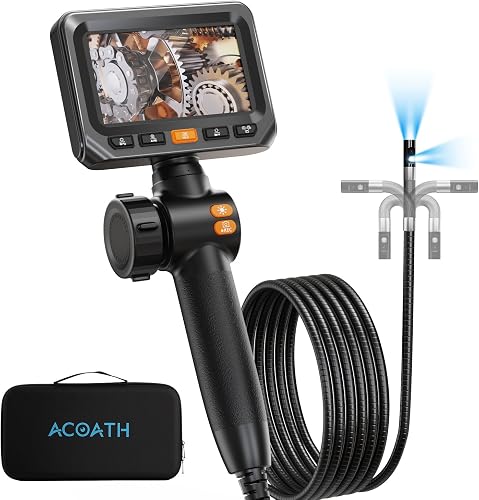
Acoath Two-Way Articulating Borescope: Best for dual-lens viewing
- Two-way 210° articulation
- Front and side cameras
- 4.3 in IPS screen
- 5 ft semi-rigid cable
The Acoath pairs a steerable probe with front and side cameras, helping inspect both straight paths and side walls without rotating the probe.
Pros
- Front and side camera switching
- 8 adjustable LEDs
- 32GB card and useful attachments
Cons
- Two-way articulation
- 570 g item weight
Acoath is the best fit when a side-facing view saves more time than four-way steering. Its front and side cameras switch with one button, so you can inspect a straight path and then look toward a pipe wall, engine surface or duct side.
The 4.3 in IPS screen displays 1920 x 1080 images, and the camera uses 8 adjustable LEDs with 4 brightness levels. That gives you more control over light in dark spaces than a fixed illumination setup.
Its 5 ft semi-rigid cable and 0.33 in probe suit common automotive, HVAC, wall and mechanical inspections. The 210° two-way articulation gives a 420° range of motion, but it does not provide the opposing-axis steering of a true four-way model.
Acoath includes a 32GB card, case, magnet, hook, mirror, protective cap, USB-C cable and manual. The 570 g body is lighter than several of the larger four-way scopes.
Pick Acoath for dual-lens work, especially when you regularly need a forward view followed by a side view in the same opening.
VEVOR 4-Way Articulating Endoscope with Light: Best for true 4-way control
- 4-way 360° articulation
- 0.24 in camera head
- 6 in IPS screen
- 4.9 ft cable
VEVOR is the strongest fit when all-direction probe steering matters. The slim camera head and large screen suit detailed work in tight, curved spaces.
Pros
- True 4-way 360° steering
- 6 in screen
- IP67-rated waterproof camera
Cons
- 2.5 lb item weight
- No flash
VEVOR is the best choice when four-way control is the main reason you're buying an articulating scope. Its probe steers through 360° coverage, which gives you more control over the viewing direction than the two-way Teslong and Acoath models.
The 0.24 in camera head is slim enough for narrow access, while the 4.9 ft flexible cable provides nearly the same reach as the 5 ft cables used by most picks here. The 6 in IPS screen is the largest display in this comparison.
The camera uses a true 1080P lens and an IP67-rated waterproof design. VEVOR also states that the 7000mAh battery supports 5–6 hours of continuous operation.
That combination suits long inspections in wet, oily or poorly lit spaces.
The trade-off is size and weight. At 2.5 lb, it is heavier than Acoath and the screen is larger to carry, although the extra viewing area helps with detailed work.
Choose VEVOR when all-direction steering and a large screen matter most, particularly for pipes, engines and complex inspection paths.
Ralcam 4-Way 360° Articulating Borescope for Mechanic: Best for slim HVAC access
- 4-way 180° articulation
- 6.2 mm lens
- 5 in screen
- 5 ft semi-rigid tube
The Ralcam combines four-way joystick control with a 6.2 mm lens and a 5 ft semi-rigid tube. It fits buyers working through ducts, pipes and mechanical spaces.
Pros
- Slim 6.2 mm lens
- 5 in 1080P screen
- Replaceable battery
Cons
- No flash
- Fixed focus
Ralcam's 4-way model is the best fit for HVAC and mechanical access where a slim 6.2 mm lens still needs joystick control. Its 5 ft semi-rigid tube balances bendability with enough support to hold the probe position through ducts, pipes and equipment.
The 5 in screen displays 1080P images and videos, and the 4-way 180° articulation gives control in multiple directions. The 4400mAh rechargeable battery is replaceable, which is useful when you want a spare power option for longer workdays.
The 6.2 mm lens is slimmer than the 0.25 in and 0.24 in probes used by several picks, but it is wider than the 3.9 mm VEVOR. That places it in the middle of the group for access size.
This Ralcam uses fixed focus and has no flash. It does have a semi-rigid cable, USB-C connection and an IP67 waterproof probe.
Pick it for slim four-way access in HVAC, plumbing and mechanical spaces, especially when a replaceable battery matters more than dual-lens viewing.
Ralcam M5 Series 4-Way Articulating Borescope: Best for replaceable probe tubes
- 4-way 360° articulation
- Replaceable snake cable
- 6.2 mm IP67 probe
- 5 in HD display
The M5 Series stands out for its replaceable snake cable. That design suits regular inspection work where the probe setup needs to change or a cable may eventually need replacement.
Pros
- Replaceable snake tube
- Detachable battery
- High-temperature warning at ≥90°C
Cons
- 720p video capture resolution
- The package lists the borescope and manual
Ralcam M5 is the standout option for inspection teams that want a replaceable snake cable. Its modular design lets you change the cable size for different inspection situations, which gives the handheld unit more long-term flexibility than a fixed-probe setup.
The 6.2 mm IP67 waterproof probe uses 6+1 high-brightness LED lights with 3 adjustable levels. The 5 in HD display supports real-time viewing, photo and video capture, and file transfer through a 32GB memory card.
A detachable 5000mAh battery supports up to 5 hours of continuous operation. The high-temperature warning activates at ≥90°C, and the unit also includes 180° image flip and 4x digital zoom.
The main trade-off is video resolution. The stated video capture resolution is 720p, lower than the 1080P capture offered by several other models here.
The package details list the borescope and manual, so this pick focuses on the replaceable cable system and inspection controls.
Choose the M5 Series for repeat professional work, where changing or replacing the snake tube is more valuable than the highest video resolution.
VEVOR Articulating Borescope with 0.15" Slim Lens: Best for ultra-narrow spaces
- 0.15 in, 3.9 mm probe
- 4-way 360° articulation
- 6 in IPS screen
- 4.9 ft cable
This VEVOR is the narrowest probe in the group, making it the focused choice for small openings. It keeps the large screen and long operating time found on the larger VEVOR design.
Pros
- Smallest probe diameter here
- 4-way 360° control
- 1920 x 1080 photo capture
Cons
- 720 x 1280 screen resolution
- 2.09 lb item weight
This VEVOR is the best pick for openings where a standard 6.2 mm probe is too wide. Its 0.15 in, 3.9 mm lens is the narrowest probe in this comparison, and the 4-way 360° articulation keeps steering control after the probe enters a tight space.
The 4.9 ft flexible snake cable works through pipes, engines and ducts. The camera has a waterproof, oil-resistant lens, 6 LED lights and 3 brightness levels for dark or wet inspection points.
A 6 in IPS screen provides a large viewing area, and the unit supports 1920 x 1080 HD photo capture, video recording, 180° image rotation and zoom settings from 1x to 8x. The 7000mAh battery supports up to 5–6 hours of continuous operation.
The screen resolution is 720 x 1280, while the camera captures 1920 x 1080 photos. That distinction matters if you expect the live view and saved image to have the same resolution.
Pick this VEVOR for ultra-narrow access, especially when the 3.9 mm probe solves an opening problem that a larger scope cannot.
DXZtoz Dual-Lens Articulating Borescope: Best for engine inspections
- 0.25 in probe
- Front and side cameras
- 5 in IPS screen
- 10x digital zoom
DXZtoz suits mechanics who need front and side views inside engines, walls or pipes. Its 5 in screen, 10x zoom and hook-and-magnet accessories support close inspection work.
Pros
- Dual-lens viewing
- 10x digital zoom
- Hands-free screen bracket
Cons
- Two-way articulation
- Manual focus
DXZtoz is the best match for engine work that needs both forward and side inspection. Its dual-lens 0.25 in probe reaches spaces such as engine openings, walls, pipes and cylinders, while a one-click switch changes between the front and side cameras.
The 5 in IPS screen is larger than the 4.3 in and 4.5 in screens on the two top two-way picks. DXZtoz also gives you 10x digital zoom, a hands-free screen bracket and a cable front-exit design.
Its two-way articulated head provides 360° rotation, but it is not the same as a four-way probe that steers across opposing directions. Manual focus also requires more attention to the inspection distance than an autofocus model.
A 3000mAh rechargeable battery has a 5-hour average life. The package includes a hook, magnet, 32GB Micro SD card, USB-C cable and carrying case.
Choose DXZtoz for engine diagnosis and side-view access, particularly when the hook, magnet and screen bracket will help during the inspection.
Zorlet 4-Way Articulating Borescope: Best for long recording sessions
- 4-way 360° articulation
- 5 in detachable IPS screen
- 9400mAh battery
- Up to 7 hours of use
Zorlet is the endurance pick, with a 9400mAh battery rated for up to 7 hours of continuous use. Its detachable screen and 32GB card suit longer inspection records.
Pros
- Longest stated battery life
- Detachable monitor
- 3x zoom and image rotation
Cons
- 3 lb item weight
- Fixed focus
Zorlet is the endurance pick for inspections that need more time between charges. Its 9400mAh rechargeable battery is rated for up to 7 hours of continuous use, the longest stated battery time in this group.
The 4-way 360° probe uses a 0.25 in/6.3 mm camera and a 5 in detachable IPS display. The screen supports 1080P viewing, image rotation, playback and 3x zoom.
A 32GB memory card and card reader support longer photo and video records.
Six adjustable LED lights with 5 brightness levels help with dark inspection areas. The probe locks at any angle, according to the product details, which supports steady viewing once you reach the inspection point.
At 3 lb, Zorlet is one of the heavier handheld choices. Its camera uses fixed focus, so it suits planned inspection distances better than work that constantly shifts from close detail to far detail.
Pick Zorlet for long recording sessions, especially when the battery and detachable monitor matter more than a lighter body.
Teslong Dual-Lens 4-Way Articulating Borescope: Best for documented findings
- 4-way 360° rotation
- Front and side cameras
- 5 in 1080P display
- Audio recording
This Teslong combines four-way control with dual cameras and audio recording. It suits technicians who need photos, video and voice notes in one inspection file.
Pros
- Front and side views
- Audio recording
- Hook, magnet and carrying case included
Cons
- 1MP photo sensor resolution
- 1.69 kg item weight
The Teslong Dual-Lens model is the best choice for documenting findings with more than pictures and video. Its built-in microphone and speaker support audio recording, so you can add spoken notes while inspecting machinery, walls, pipes or equipment.
The four-way probe rotates 360° and bends 210°. Dual 1.0MP cameras switch between front and side views, while 6 adjustable LEDs on the front camera and 1 LED on the side camera provide separate illumination.
A 5 in IPS display shows 1080P photos and video. The 3000mAh rechargeable battery supports extended operation, and the included 32GB Micro SD card stores captured files.
The kit also includes a hook, magnet, carrying case, cable and manual.
The photo sensor resolution is 1MP, lower than the 2MP or 2.07MP values listed for several other models. At 1.69 kg, this Teslong is also heavier than the 570 g Acoath.
Choose it for inspection records with voice notes, especially when a side camera and four-way control are both useful.
How do these borescopes compare?
The best 4-way articulating borescope depends on whether you value steering range, probe diameter, dual-lens viewing or battery life. The table below puts the main differences in one place.
| Product | Best for | Articulation | Probe | Screen | Our score |
|---|---|---|---|---|---|
| Teslong Articulating Borescope for Mechanic Automotive HVAC | most inspections | Two-way 210° | 5 ft semi-rigid gooseneck | 4.5 in IPS color screen | 9.6 |
| Acoath Two-Way Articulating Borescope | dual-lens viewing | Two-way 210°, 420° range | 0.33 in, 5 ft semi-rigid cable | 4.3 in IPS, 1920 x 1080 | 9.6 |
| VEVOR 4-Way Articulating Endoscope with Light | true 4-way control | 4-way 360° | 0.24 in, 4.9 ft cable | 9.4 | |
| Ralcam 4-Way 360° Articulating Borescope for Mechanic | slim HVAC access | 4-way 180° | 6.2 mm, 5 ft semi-rigid tube | 8.9 | |
| Ralcam M5 Series 4-Way Articulating Borescope | replaceable probe tubes | 4-way 360° | 6.2 mm, 5 ft | 8.7 | |
| VEVOR Articulating Borescope with 0.15" Slim Lens | ultra-narrow spaces | 4-way 360° | 0.15 in, 3.9 mm | 8.4 | |
| DXZtoz Dual-Lens Articulating Borescope | engine inspections | 0.25 in, 5 ft | 8.2 | ||
| Zorlet 4-Way Articulating Borescope | long recording sessions | 4-way 360° | 0.25 in/6.3 mm, 5 ft | 8.0 | |
| Teslong Dual-Lens 4-Way Articulating Borescope | documented findings | 0.25 in, 5 ft | 7.5 |
Four-way control is strongest on the VEVOR, Ralcam M5, Zorlet and Teslong Dual-Lens models. The Ralcam 4-Way model states 4-way 180° articulation, while the other four-way options state 360° coverage or rotation.
The narrowest probe is the VEVOR 0.15 in model at 3.9 mm. The 6.2 mm Ralcam models are still slim, but their larger probe may not fit every opening.
Measure the access point and account for bends before choosing a diameter.
For dual-lens viewing, Acoath, DXZtoz and Teslong Dual-Lens are the direct choices. They let you change from a forward view to a side view, which can reduce probe repositioning inside an engine, wall or pipe.
Battery life favors Zorlet, with up to 7 hours, followed by the VEVOR models at up to 5–6 hours. The Teslong, Acoath and Ralcam options state about 5 hours or up to 5 hours.
Does four-way articulation matter for your inspection?
Four-way articulation matters most when the inspection path curves or the target can sit above, below or to either side of the probe. It gives you more steering choices without twisting the cable by hand.
A two-way scope still makes sense for straight paths and side-view work. Acoath's dual cameras can be more useful than four-way steering when you need to see both the end of a path and a nearby wall.
The explanation of how an articulating borescope works covers the control idea in more detail. In simple terms, the handle changes the direction of the camera head, while the cable carries the probe into the inspection space.
Choose four-way control for complex paths
Pick the VEVOR 4-Way or Ralcam M5 when the camera must point in several directions after entering a tight space. Zorlet is the better endurance choice, while Teslong Dual-Lens adds audio and dual-camera documentation.
Choose two-way control for simpler access
Pick the Teslong overall model for a balanced handheld design. Choose Acoath or DXZtoz when a side camera is more useful than steering across four directions.
What probe size should you choose?
Probe size should match the smallest opening you expect to inspect. The 3.9 mm VEVOR is the narrowest option here, followed by the 6.2 mm Ralcam models and the 0.24–0.25 in probes used by several other picks.
A smaller probe helps with tight access, but it is only one part of the decision. You also need enough cable stiffness to guide the camera and enough screen detail to identify the feature you are checking.
For ultra-narrow openings
Choose the VEVOR Articulating Borescope with 0.15 in Slim Lens. Its 3.9 mm probe is the clear choice when a 6.2 mm camera will not fit.
For general HVAC and mechanical work
Choose the Ralcam 4-Way model with its 6.2 mm lens and 5 ft semi-rigid tube. It gives a practical middle ground between narrow access and a larger camera body.
Is a dual-lens borescope better than a single-lens model?
A dual-lens borescope is better when you often need to inspect both straight ahead and toward the side of the probe. It is less useful when the main problem is steering around several bends.
Acoath uses a front lens and side lens with one-button switching. DXZtoz adds a 5 in screen, 10x digital zoom and a hands-free bracket.
The Teslong Dual-Lens model adds four-way control, audio recording and a 32GB card.
For a lighter dual-lens kit
Choose Acoath. Its 570 g item weight is lower than the other dual-lens models here, and the package includes a hook, magnet, mirror and protective cap.
For engine detail and zoom
Choose DXZtoz. Its 10x digital zoom, dual-path thumb stick and front-exit cable design suit close engine inspections.
For reports with voice notes
Choose the Teslong Dual-Lens model. Its microphone and speaker let you record spoken observations with the inspection files.
Which screen and lighting features help most?
A larger screen helps you view small cracks, corrosion, blockages and mechanical details without relying on a phone. The VEVOR four-way models have 6 in screens, while most other picks use 4.3 in or 5 in displays.
Lighting control matters just as much. Adjustable LEDs help when a surface reflects too much light or the inspection point is almost dark.
For the largest screen
Choose either VEVOR model with a 6 in IPS screen. The standard VEVOR combines that display with a true 1080P lens, while the slim VEVOR adds the 3.9 mm probe.
For flexible lighting
Choose Acoath if you want 8 LEDs with 4 adjustable levels. Choose Zorlet if 6 LEDs with 5 brightness levels matter more.
For a simple no-app setup
Choose the Teslong overall model. Its 4.5 in IPS screen works without an app, and the camera has built-in adjustable LED lighting.
How much battery life do you need?
Five hours covers most individual inspections, while longer battery ratings help when you are recording across several vehicles, HVAC runs or equipment checks. Battery size alone does not guarantee actual working time in every situation.
Zorlet has the longest stated operating time at up to 7 hours. Both VEVOR models state up to 5–6 hours, and Teslong, Acoath, Ralcam M5 and DXZtoz sit around 5 hours.
For the longest stated use
Choose Zorlet for its 9400mAh battery and up to 7 hours of continuous operation. The detachable monitor and 32GB card also suit longer documentation sessions.
For a replaceable power setup
Choose Ralcam 4-Way because its 4400mAh battery is replaceable. Choose Ralcam M5 if you also want a detachable 5000mAh battery and replaceable snake cable.
What should you record during an inspection?
Record the location, direction, visible condition and file name while the camera is inside the inspection area. Photos show a specific detail, while video preserves the route and context.
A 32GB card is included with Teslong overall, Acoath, VEVOR slim, Ralcam M5, Zorlet, DXZtoz and Teslong Dual-Lens. The Ralcam 4-Way package includes the camera, USB cable, case and manual, so its documentation setup is simpler.
For photo and video records
Choose Zorlet or VEVOR. Zorlet adds playback, image rotation and 3x zoom, while VEVOR supports HD photos, video and 8x optical or digital zoom details depending on the model.
For spoken notes
Choose Teslong Dual-Lens. Audio recording keeps your observations with the inspection files instead of requiring separate notes.
Verdict: which is the best 4-way articulating borescope?
The Teslong Articulating Borescope for Mechanic Automotive HVAC is the best overall pick for most people because its 5 ft semi-rigid cable, 4.5 in IPS screen, adjustable lighting, no-app operation and central joystick cover the widest range of routine inspections. Its two-way articulation is the main trade-off, but the complete handheld setup is easy to match to automotive, HVAC, wall and household work.
Choose the VEVOR 4-Way Articulating Endoscope with Light when true four-way 360° steering, a 0.24 in camera head and a 6 in screen matter most. Choose the slim VEVOR when the opening is only wide enough for a 3.9 mm probe.
Choose Acoath for dual-lens viewing and a lighter body, DXZtoz for engine work with 10x zoom, and Ralcam M5 when a replaceable snake tube is worth more than 1080P video capture. Pick Zorlet for the longest stated battery life, or Teslong Dual-Lens when four-way control and audio notes belong in the same inspection kit.
Our top 3 picks at a glance
-
1
Best for most inspections
Teslong Articulating Borescope for Mechanic Automotive HVAC
9.6/10 our score
See it on Amazon -
2
-
3
Best for true 4-way control
VEVOR 4-Way Articulating Endoscope with Light
9.4/10 our score
See it on Amazon
Frequently asked questions
What is the difference between two-way and four-way articulation?
Two-way articulation bends the probe in one plane, while four-way articulation steers it in opposing directions for broader control. A two-way scope can still be the better choice when dual-lens viewing matters more than all-direction steering.
What probe diameter is best for a borescope?
Choose the smallest probe that fits the opening while still giving you the reach and control you need. The 3.9 mm VEVOR suits ultra-narrow access, while 6.2 mm models offer a larger probe for general inspection work.
Do articulating borescopes work in wet areas?
Several picks here have waterproof camera details, including the IP67-rated VEVOR camera and IP67 probes on the Ralcam models. Keep the waterproof rating tied to the camera or probe, not automatically to the handheld display.
Is a dual-lens borescope better for engine work?
A dual-lens scope is useful when you need both a forward view and a side view. Acoath, DXZtoz and the Teslong Dual-Lens model switch between camera angles, reducing the need to reposition the probe for every detail.
How long should an articulating borescope cable be?
A 5 ft cable covers many automotive, HVAC, wall and equipment inspections without adding much handling difficulty. Longer reach matters when the opening and the inspection point are far apart, but the products compared here use cables close to 5 ft.