9 Best Sewer Cameras for Home Inspectors (November 2026)
The best sewer cameras for home inspectors include the ANYSUN Sewer Camera for full inspection days, the VEVOR 98 ft Sewer Camera for long drain runs, and the ChoosePRO 7-Inch Sewer Camera for sharp, zoomed-in findings.
On this page (9 sections)
- The best sewer cameras for home inspectors
- How these sewer cameras compare
- How we chose these cameras
- What should a home inspector look for in a sewer camera?
- Do you need a self-leveling camera for home inspections?
- Should you pay for a locator built into the camera?
- Which sewer camera is easiest to use on a busy schedule?
- What do you give up with a cheaper sewer camera?
- Verdict: which sewer camera should a home inspector buy?
The best sewer camera for home inspectors is the ANYSUN Sewer Camera, with a 7-inch screen, a 1000TVL lens and up to 9 hours of battery for a full day of drain checks. Pick the VEVOR 98 ft when the lateral runs long, or the ONDASHCAM when you need self-leveling and a built-in locator transmitter.
A home inspector uses a sewer camera differently from a plumber. You're usually at a cleanout or a floor drain, checking a short stretch of pipe for cracks, roots and blockages while the buyer waits.
The camera needs to be quick to set up, easy to read in daylight and simple to record so you can attach the footage to your report. Our score weighs specs, features and how well each camera fits that kind of day against what you're shopping for.
If you want the broader field first, our sewer camera guide covers the general-purpose picks, and the sewer camera with locator roundup goes deeper on tracing buried lines.
Our picks at a glance
-
1

-
2
-
3
- 4
 Check it
VISIOPROBE 100 ft Sewer Camera
Best for all-day outdoor work - 5
 Check it
Teslong 50 ft Dual-Lens Drain Camera
Best for pipe wall checks - 6
 Check it
ONDASHCAM 100 ft Self-Leveling Camera With Transmitter
Best for tracking a buried line - 7
 Best for keeping the kit tidyCheck it
- 8
 Check it
Seenezader 100 ft Sewer Camera
Best for tight pipe bends - 9
 Check it
Gatebig 164 ft Self-Leveling Camera With Locator
Best for long municipal and lateral runs
The best sewer cameras for home inspectors
ANYSUN takes the top spot for the typical inspection day because the big screen and long battery remove the two most common interruptions. Every other pick here wins on a specific job, from long runs to pipe-wall checks.
ANYSUN Sewer Camera: Best for full inspection days
- 7-inch LCD screen
- 1000TVL camera with 140° view
- IP68 waterproof 23mm head
- 4500mAh battery, up to 9 hours
- 8GB SD card included
A 7-inch screen and a long-lasting battery make this the easiest camera to run through a whole day of home drain checks.
Pros
- Large 7-inch screen
- Up to 9 hours of runtime
- Recording to the included 8GB card
- 12 adjustable LEDs
Cons
- No self-leveling
- No locator transmitter
ANYSUN fits the inspector who walks from house to house and needs one camera to do the job without fuss. The 7-inch LCD is the largest screen among the top picks, and its sun visor keeps the picture readable when you're standing in a driveway.
The 1000TVL camera head measures 0.9 in (23mm) and is IP68 waterproof, so it handles wet traps and standing water. It suits pipes from 1 to 8 in (25 to 200mm), covering the sink, tub and main-line checks a home inspection usually includes.
The 140° view and 12 adjustable LEDs help in dark, deep runs.
Runtime is the strongest case for it here. ANYSUN rates the 4500mAh battery at about 9 hours, which covers several inspections before a recharge.
The included 8GB SD card records video and stills for your report.
Buy it for everyday residential inspection work where screen size and battery life matter most. The trade-off is the lack of a self-leveling head and a locator, so look further down this list if you need either one.
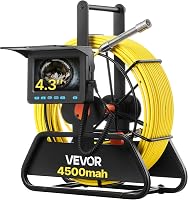
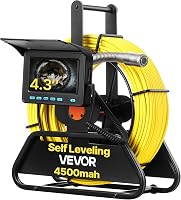
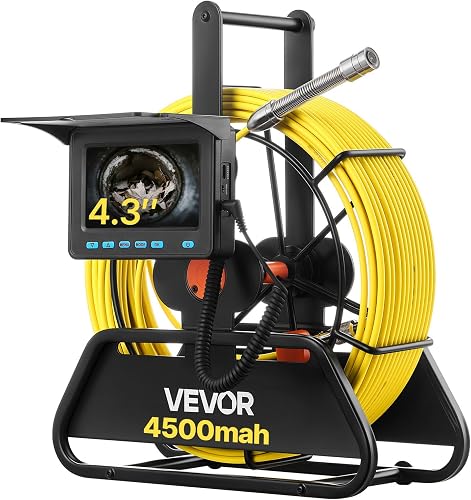
VEVOR 98 ft Sewer Camera: Best for long drain runs
- 98 ft fiberglass cable with distance markings
- 4.3-inch color screen
- 6 LEDs with 3 brightness levels
- 4500mAh battery, about 5 hours
The 98 ft marked cable reaches further into main lines than most picks here, and the price tier keeps it within reach for a first camera.
Pros
- 98 ft cable with distance markings
- Handles two consecutive 90° bends in 1.97 to 3.93 in pipe
- 16GB SD card included
Cons
- Smaller 4.3-inch screen
- 480P camera resolution
- No self-leveling or locator
VEVOR suits the inspector whose jobs include longer laterals and main lines. Its 98 ft fiberglass cable is marked in feet, so you know how far you've pushed without guessing, and the semi-rigid build handles two consecutive 90° bends in 1.97 to 3.93 in pipe.
The 4.3-inch screen is smaller than ANYSUN's, and the camera resolution is 480P. For finding a blockage or confirming a drain runs clear, that's enough.
For zooming in on a hairline crack, the 1080P picks further down do better.
VEVOR lists the pipe range as 1.18 to 3.93 in for straight runs and 1.97 to 3.93 in for right-angle pipes. That covers most residential drain work but rules out very small branch lines.
The 120° view and six LEDs with three brightness levels suit varied lighting.
The 4500mAh battery runs about 5 hours, so plan a mid-day charge on a busy schedule. A 16GB SD card comes in the kit.
Buy it for long, straight main-line runs at a lower price tier than the 1080P options. Skip it if you need a big screen or high-resolution detail for report photos.
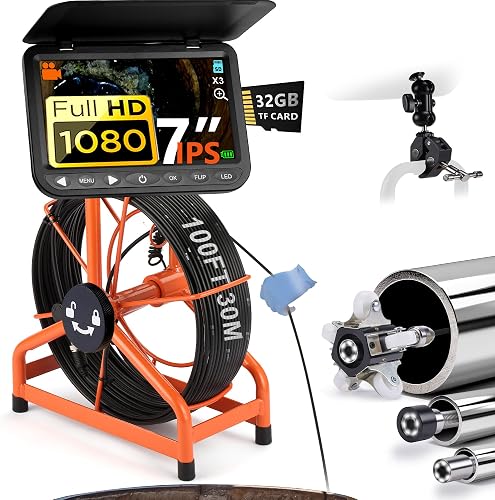
ChoosePRO 7-Inch Sewer Camera: Best for sharp, zoomed-in findings
- 1080P camera with 7-inch IPS screen
- 16x digital zoom
- 32GB card included
- 5000mAh battery, over 8 hours
- 1-second twist cable reel
A 1080P lens and 16x zoom help an inspector confirm hairline cracks, and the quick-release reel speeds up cable handling between jobs.
Pros
- 1080P image with 16x zoom
- Twist-release cable reel
- 32GB card included
- Two camera sleeves for small and large pipes
Cons
- No self-leveling or locator
ChoosePRO suits the inspector who needs sharp images for written reports. Its 1080P lens and 7-inch IPS screen pair with a 16x zoom, so you can enlarge a joint or a crack and still see the detail clearly.
The cable runs 100 ft and is marked in feet. A 1-second twist releases the reel, which saves time coiling and releasing cable between stops.
The 5000mAh battery runs over 8 hours, and a 32GB card comes in the kit. Footage can move to a PC by card or USB-C.
The camera head is IP68 waterproof, and ChoosePRO includes 25mm and 84mm sleeves so the probe sits better in small or large pipes. Six adjustable LEDs with three brightness levels handle dark runs.
This is the pick when your reports lean on photos and video. The lack of self-leveling means the picture rolls as the cable turns, so you'll describe orientation from the footage rather than reading it straight off the screen.
Buy it for report-quality images and quick cable handling. Skip it if you need a locator or a level picture.
VISIOPROBE 100 ft Sewer Camera: Best for all-day outdoor work
- 100 ft fiberglass cable with depth markers
- 4.3-inch monitor with sun visor
- 8500mAh battery, up to 10 hours
- 1080P AHD camera, IP68 head
- 32GB card included
The biggest battery here runs 10 hours, so a long day of crawlspace and yard checks needs fewer charging breaks.
Pros
- Up to 10 hours of runtime
- Sun visor for outdoor viewing
- Two protective heads with wheels
- 32GB card included
Cons
- No self-leveling or locator
- 4.3-inch screen
VISIOPROBE suits the inspector who works outside in bright sun and long days. The 8500mAh battery runs up to 10 hours, the longest in this group, so a full schedule of yard and crawlspace checks needs fewer breaks.
Its 4.3-inch IPS monitor has a built-in sun visor, which helps when you're checking a cleanout in full daylight. The 1080P AHD camera head is 23mm and IP68 waterproof, with 12 adjustable LEDs and a 145° view.
Night vision aids in deep, dark pipe.
The 100 ft fiberglass cable is marked in depth, and the kit includes two protective heads with wheels for different pipe diameters. A 32GB card records video and photos on the device for later review on a PC.
The screen is smaller than ANYSUN's, so reading fine detail takes more squinting. It also lacks self-leveling and a locator.
Buy it for long outdoor days and maximum runtime. Skip it if a big screen or locator is on your list.
Teslong 50 ft Dual-Lens Drain Camera: Best for pipe wall checks
- Front and side cameras on split screen
- 4.3-inch IPS display, tilts 180°
- 50 ft semi-rigid cable
- 3000mAh battery
- Hook, magnet and mirror included
The split screen shows the pipe ahead and the wall at once, which helps an inspector spot cracks and root intrusion without swapping mirrors.
Pros
- Dual cameras in one pass
- Tilting, rotating display
- Light 50 ft cable for sink and floor drains
Cons
- Limited flexibility through tight 90° elbows and P-traps
- Shortest cable in this group
- Memory card sold separately
Teslong suits the inspector who wants to see the pipe wall without stopping to fit a mirror. Its front and side cameras share a split screen, so you see what's ahead and what's beside the probe at the same time.
The front camera carries six LEDs and the side camera one.
The 4.3-inch IPS display tilts and rotates 180°, which helps when you're reading it over a manhole or under a sink. The 3000mAh battery covers a day of drain checks, and the kit includes a hook, magnet and side mirror.
The 50 ft semi-rigid cable is the shortest here. It's enough for sink, tub and floor drains and short lateral runs, but not for reaching far down a main line.
Teslong notes the cable has limited flexibility through tight 90° elbows and P-traps.
The dual view is the reason to choose it. Spotting a crack in the pipe wall in the same pass as the blockage saves time and gives the buyer a clearer picture.
The memory card is sold separately.
Buy it for pipe-wall and root checks on shorter runs. Skip it for long main lines or when you need a locator.
ONDASHCAM 100 ft Self-Leveling Camera With Transmitter: Best for tracking a buried line
- Self-leveling 0.9-inch camera
- 512Hz sonde transmitter built in
- 9-inch IPS 1080P screen
- 100 ft cable with meter marks
- 5100mAh battery, up to 10 hours
A self-leveling picture and a built-in transmitter make this the pick when the goal is finding a buried line, not just seeing inside it.
Pros
- Self-leveling image
- 512Hz transmitter built in
- 9-inch screen
- Up to 10 hours of runtime
Cons
- Locator receiver not included
- Higher price tier
ONDASHCAM suits the inspector who needs to find a buried line, not just look inside it. Its 512Hz sonde transmitter is built into the camera head, so any 512Hz receiver (not included) can trace the pipe from above ground and mark the defect for excavation.
The camera head is self-leveling at 0.9 in, so the picture stays upright as the probe turns. A 9-inch IPS 1080P screen is the largest in this group, and the 100 ft cable carries meter marks for depth.
The 140° view and 12 stepless LEDs handle dark, wet pipe.
The 5100mAh battery runs up to 10 hours. A 32GB micro SD card is included and the slot takes up to 128GB.
The kit ships in a heavy-duty carrying case with a power indicator so you know when to recharge.
The receiver is a separate purchase, so the locator setup costs more than a plain camera. The price tier is higher than the ANYSUN and VEVOR.
Buy it when locating matters and you're prepared to add a receiver. For simple visual checks, a cheaper camera does the job.
KCapyn 100 ft Sewer Camera: Best for keeping the kit tidy
- 100 ft semi-rigid cable with distance marks
- 5-inch DVR screen
- 32GB card included
- 5000mAh battery
- Built-in tool box storage
The camera and screen sit inside a sturdy orange tool box, so the probe, hooks and adapters all travel in one case.
Pros
- Everything stores in one tool box
- 32GB card included
- 100 ft marked cable
Cons
- No self-leveling or locator
- 5-inch screen
KCapyn suits the inspector who wants the kit to stay in one place. The camera and screen sit inside a sturdy orange tool box, and the probes, hooks and adapters store in the same case, so nothing gets lost between jobs.
Its 100 ft semi-rigid cable has distance marks for depth. The 5-inch DVR screen records video and stills to the included 32GB card.
The 5000mAh battery covers a workday.
The 1080P lens is IP68 waterproof and handles damp, greasy pipe. Six LEDs with automatic flash help in dark runs.
The tool box design means setup is fast: open the lid and you're ready.
The screen is smaller than the 7-inch and 9-inch options, and the kit has no self-leveling or locator. The tool box also adds bulk compared with a soft bag.
Buy it for tidy storage and fast setup between inspections. Skip it if screen size or locating is the priority.
Seenezader 100 ft Sewer Camera: Best for tight pipe bends
- 100 ft cable with digital length counter
- 5-inch 1080P screen
- 32GB card included
- 5000mAh battery, 6 to 8 hours
- 17mm head with flexible spring
A 17mm head and flexible spring tip work through 90° bends in 8-inch pipe, which helps when the drain has tighter corners.
Pros
- Flexible spring tip for 90° bends
- Digital length counter
- 32GB card included
Cons
- No self-leveling or locator
- Cable is only 5mm in diameter
- 6 to 8 hours of runtime
Seenezader suits the inspector whose drains have tighter corners. Its 17mm head and flexible spring tip work through 90° bends in 8-inch pipe, where stiffer cables can jam.
The 100 ft semi-rigid cable has a digital length counter, so you know exactly how far the probe has gone. The 5-inch 1080P screen records to the included 32GB card.
The 5000mAh battery runs 6 to 8 hours. The cable itself is thin at 5mm.
The IP68 head works up to 10 meters underwater, and 6 adjustable LEDs with a 140° view handle dark runs. A 25mm protective cover helps the probe sit better in larger pipe.
The 5mm cable is thinner than the fiberglass cables on the other picks, so it flexes more but may kink sooner under hard pushing. The kit has no self-leveling or locator.
Buy it for tighter bends and short to medium runs. Skip it for long municipal laterals or locating work.
Gatebig 164 ft Self-Leveling Camera With Locator: Best for long municipal and lateral runs
- 164 ft 7mm fiberglass cable
- Self-leveling 9-inch IPS screen
- 512Hz locator with receiver
- 12 adjustable LEDs
- 5100mAh cold-resistant battery
The longest cable here reaches 164 ft, and the locator kit includes the receiver so you can trace a line without buying more gear.
Pros
- 164 ft cable
- Self-leveling image
- Locator receiver included
- Trolley and wheels for transport
Cons
- Largest and heaviest system here
- Receiver needs its own battery
- Lowest score in this group
Gatebig suits the inspector who works long lateral runs and needs to mark the spot. Its 164 ft 7mm cable is the longest here, and the kit includes a 512Hz locator receiver so you can trace the line without buying more gear.
The receiver needs its own battery, sold separately.
The camera head is self-leveling, and the 9-inch IPS screen shows a clear real-time picture. A 16GB TF card records video and stills.
Twelve adjustable LEDs and an IP68 stainless housing with a sapphire lens handle wet, flooded pipe.
The 5100mAh battery runs up to 8 hours and Gatebig says it holds up in cold winter conditions. A trolley and wheels make the system easier to move.
It's the largest and heaviest kit here. The 7mm cable is built for long runs but stiffer in tight bends than the thinner options.
Buy it for long runs and locating when portability matters less. Skip it if you want a light kit for quick house calls.
How these sewer cameras compare
| Product | Best for | Screen | Camera head | Battery | Our score |
|---|---|---|---|---|---|
| ANYSUN Sewer Camera | full inspection days | 7 in LCD | 23mm | 4500mAh | 8.8 |
| VEVOR 98 ft Sewer Camera | long drain runs | 4.3 in color | 8.6 | ||
| ChoosePRO 7-Inch Sewer Camera | sharp, zoomed-in findings | 7 in IPS | 5000mAh | 8.0 | |
| VISIOPROBE 100 ft Sewer Camera | all-day outdoor work | 4.3 in IPS | 8500mAh | 7.9 | |
| Teslong 50 ft Dual-Lens Drain Camera | pipe wall checks | 4.3 in IPS | 7.8 | ||
| ONDASHCAM 100 ft Self-Leveling Camera With Transmitter | tracking a buried line | 9 in IPS | 7.6 | ||
| KCapyn 100 ft Sewer Camera | keeping the kit tidy | 5 in | 7.3 | ||
| Seenezader 100 ft Sewer Camera | tight pipe bends | 5 in | 7.1 | ||
| Gatebig 164 ft Self-Leveling Camera With Locator | long municipal and lateral runs | 9 in IPS | 7.0 |
How we chose these cameras
We started with the job: a home inspector at a cleanout, checking a drain for cracks, roots and blockages while a buyer waits. We checked each camera's screen size, cable length, camera resolution, battery life, waterproof rating and locator features against that job.
Screen size got the most weight. A 7-inch or 9-inch screen is easier to read in daylight than a 4.3-inch one, and reading the picture is most of the work.
Cable length came next, since a 50 ft cable covers drains but not main lines.
Battery life decided the top pick. A camera that runs 9 or 10 hours covers several inspections without a recharge.
We also noted whether a kit includes a memory card and whether the camera head is self-leveling.
The score reflects how well each camera fits the inspection day. A camera with a big screen and long battery scores higher than one that only adds a locator.
If you're comparing two close options, our Anysun vs VEVOR sewer camera piece goes through the differences in detail.
What should a home inspector look for in a sewer camera?
A home inspector should prioritize screen size, cable length, battery life and recording over locator features. The camera is a reporting tool, so a clear picture and easy video capture matter more than tracing a line to the inch.
Look at the camera head diameter too. A 17mm to 23mm head fits most residential drains from 1 to 8 in.
A larger head won't get through small branch lines. The ANYSUN and VISIOPROBE both use 23mm heads, while the Seenezader goes smaller at 17mm for tighter bends.
Is a 7-inch screen big enough for daylight inspections?
Yes, for most work. A 7-inch screen is large enough to read cracks and joints while you're crouched at a cleanout.
A 9-inch screen helps more in bright sun. A 4.3-inch screen suits quick checks but takes more squinting for detail.
How long a cable covers a typical home drain?
A 50 ft cable covers sink, tub and floor drains and short lateral runs. A 100 ft cable reaches from a cleanout into the main line toward the street.
For long municipal laterals or deep runs, a 164 ft cable like the Gatebig's gives more reach.
Do you need a self-leveling camera for home inspections?
Only if you want the picture to stay upright as the probe turns. A self-leveling camera head keeps the image upright, so you can say whether a crack is at the top or bottom of the pipe without correcting the orientation yourself.
Without it, the image rolls as the cable twists. You can still read the pipe, but you'll describe orientation from the footage rather than reading it off the screen.
For report writing, self-leveling saves time.
When self-leveling is worth the extra cost
Self-leveling helps most when your reports describe defect position, such as a crack at the crown of the pipe. The ONDASHCAM and Gatebig both have self-leveling heads.
If your reports are mostly "drain clear" or "blockage found", a plain camera works fine.
When a plain camera is the better buy
A plain camera costs less and does the basic job. The ANYSUN, VEVOR and ChoosePRO have no self-leveling but score higher overall on screen size, battery and image quality.
For most residential inspection days, those matter more.
Should you pay for a locator built into the camera?
Pay for a locator when you need to mark a defect's exact position for a plumber or buyer. A 512Hz transmitter in the camera head sends a signal that a receiver picks up above ground, so you can mark the spot without digging.
The ONDASHCAM includes the transmitter but not the receiver. The Gatebig kit includes both.
If locating is rare in your work, skip the feature and save the money. For a self leveling sewer camera with a locator, those two picks are the ones to compare.
Which sewer camera is easiest to use on a busy schedule?
The ANYSUN is the easiest for most inspectors because the big screen and long battery remove the two most common interruptions. The ChoosePRO's twist-release reel and the KCapyn's tool box design also save time between jobs.
Setup speed matters when you have three inspections in a day. A camera that stores in one case and starts recording with one button keeps you moving.
A camera with a big screen means less time squinting and more time writing the report. The Gatebig's trolley and wheels help when the day's jobs spread across a large property.
Setup and cable handling
The ChoosePRO reel releases in 1 second with a twist. The KCapyn kit packs into a tool box.
The ANYSUN and VISIOPROBE use a standard reel and monitor mount. Pick the handling style that matches how you travel between jobs.
Battery and charging on the road
Look for at least 8 hours of runtime. The VISIOPROBE's 8500mAh battery runs up to 10 hours, the longest here.
The ANYSUN and ChoosePRO run about 8 to 9 hours. A USB-C power bank can top up the ChoosePRO while it's in use.
The ONDASHCAM's built-in power indicator shows remaining charge at a glance, and its battery runs up to 10 hours.
What do you give up with a cheaper sewer camera?
A cheaper camera usually gives up screen size or resolution, not the core job. The VEVOR's 480P camera and 4.3-inch screen find blockages fine.
The ANYSUN's 1000TVL lens and 7-inch screen cost more but read detail better.
The price tier you choose depends on your reports. If you attach video to every inspection, a sharper camera earns its keep.
If you mainly confirm a drain is clear, a lower-tier kit does the job. The trade-off also shows in the kit itself: cheaper models tend to ship without a memory card, a locator or a protective sleeve set.
Verdict: which sewer camera should a home inspector buy?
For most home inspectors, the ANYSUN Sewer Camera is the best sewer camera for home inspectors because the 7-inch screen and 9-hour battery fit a full day of drain checks. Buy the VEVOR 98 ft if long main-line runs matter more than screen size.
Choose the ONDASHCAM when you need self-leveling and a transmitter for locating, or the Gatebig for the longest runs and a receiver in the box.
If you're still weighing options, the best sewer camera guide covers general-purpose picks and the self leveling sewer camera roundup goes deeper on upright imaging. For a head-to-head on two close picks, read our Anysun vs VEVOR sewer camera comparison before you buy.
Our top 3 picks at a glance
-
1
-
2
-
3
Frequently asked questions
How long a cable do I need for home sewer inspections?
Most home inspections work within 50 to 100 ft of cable. A 50 ft cable covers sink, tub and floor drains and short lateral runs.
A 100 ft cable reaches from a cleanout into the main line toward the street, which is where root intrusion and bellies usually show up.
Do I need a sewer camera with a locator as a home inspector?
A locator helps when you need to mark the exact depth and position of a defect for the plumber or buyer. A 512Hz transmitter in the camera head plus a receiver pinpoints the spot from above ground.
For simple visual checks inside the drain, a camera without a locator covers the job.
What does self-leveling mean on a sewer camera?
A self-leveling camera head keeps the picture upright as the probe turns inside the pipe. Without it, the image rolls as the cable twists, and you have to correct the orientation in your head.
Self-leveling makes it easier to describe whether a crack sits at the top or bottom of the pipe.
Is a 1080P sewer camera better than a 1000TVL camera?
Both give a clear view, and the difference matters most when you zoom in. A 1080P camera holds detail better when you enlarge a frame to inspect a hairline crack or a joint.
A 1000TVL camera is fine for finding blockages and confirming a drain is clear.
How long should a sewer camera battery last on a home inspection day?
Plan for at least 8 hours if you do several inspections in a day. A 4500mAh battery runs about 9 hours on the ANYSUN, while larger 8500mAh packs reach 10 hours.
A second battery or a USB-C power bank keeps a long day from ending early.