Borescope vs Videoscope: What Is the Difference? (November 2026)
A videoscope is a borescope with a live screen and camera-based viewing system. Choose the MugEasy for a simple pipe and wall inspection, or the Teslong for probe control and saved inspection files.
On this page (11 sections)
- Borescope vs videoscope: what is the basic difference?
- How do the MugEasy and Teslong compare?
- Which camera gives you more reach?
- Which one handles corners better?
- Which screen makes inspection easier?
- Which camera is better in dark or wet spaces?
- Which borescope is better for saving evidence?
- Which camera is easier to carry and control?
- Who should buy the MugEasy?
- Who should buy the Teslong?
- Borescope vs videoscope: which should you choose?
A videoscope is a camera-based borescope with a built-in screen, and the higher-scored MugEasy is the better overall choice here. Its 16.6FT cable, narrow 7.9mm probe, 8 LED lights and IP67 waterproof camera fit more general pipe, wall and vehicle inspections.
The Teslong wins when probe steering and saved files matter more than reach. Its two-way 210° articulation, 32GB Micro SD Card and photo button give it a clear advantage for mechanics and HVAC work that requires a controlled view or inspection record.
This borescope vs videoscope comparison uses the everyday meaning of both terms. In practice, the tools overlap heavily.
The useful differences are the camera head, cable, screen, lighting, recording and the type of space you need to inspect.

 Best for controlled probe views
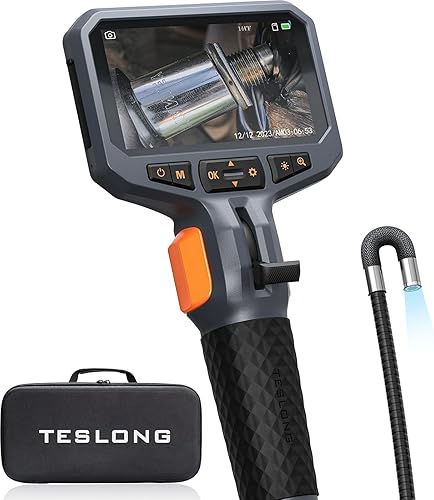
Teslong Articulating Borescope for Mechanic Automotive HVAC
Borescope vs videoscope: what is the basic difference?
A borescope describes the inspection tool, while a videoscope emphasizes the camera and live display. Both let you see inside narrow or blocked areas without opening the whole object.
Traditional borescopes can use an optical tube, eyepiece or camera. A videoscope sends the camera image to a screen, so you can hold the handle while viewing the inside of a pipe, wall cavity, engine area or appliance.
Modern handheld products often fit both names. The MugEasy has a 4.3-inch IPS screen and captures 1920x1080P HD images in real time.
The Teslong has a 4.5-inch IPS color screen and a 2.0MP HD endoscope.
The labels alone don't tell you which tool is better. A long cable matters more for a drain pipe, while probe articulation matters more when you need to look behind a bracket or around a tight bend.
The word videoscope also doesn't guarantee recording. The MugEasy displays video but cannot take or store photos.
The Teslong includes a 32GB Micro SD Card and has a photo button for saving images or videos.
How do the MugEasy and Teslong compare?
The MugEasy wins overall for reach and general inspection work; the Teslong wins for directional control and file storage. Their different cable designs make them suited to different inspection habits.
| Feature | MugEasy Endoscope Camera with Light | Teslong Articulating Borescope for Mechanic Automotive HVAC |
|---|---|---|
| Overall score | 9.7 | 9.6 |
| Screen | 4.3-inch IPS | 4.5-inch IPS |
| Probe | 7.9mm camera probe | 2.0MP HD endoscope |
| Cable | 16.6FT semi-rigid cable | 5FT semi-rigid gooseneck |
| Camera movement | Bendable cable | Two-way 210° articulation |
| Lighting | 8 adjustable LED lights | Built-in adjustable LED lights |
| Waterproofing | IP67 | IP67 |
| Storage | Cannot take or store photos | 32GB Micro SD Card |
| Best match | Pipes, walls and general checks | Automotive and HVAC spaces |
The MugEasy reaches more than 3 times as far by cable length. Its 1.29 in short lens and 7.9mm probe also suit narrow openings.
The Teslong gives you more control at the camera head. Its centrally located articulating joystick lets you turn the probe in 2 directions while viewing the result on the screen.
Which camera gives you more reach?
Choose the MugEasy when the inspection point is far inside a pipe, wall or vehicle. Its 16.6FT semi-rigid cable gives you more working distance than the Teslong's 5FT gooseneck.
Longer reach helps when the opening is easy to access but the problem is far away. You can keep the handle outside the work area while sending the camera deeper into a drain, wall cavity or engine compartment.
The MugEasy cable is semi-rigid and can be bent into position. That gives it enough stiffness to push the probe forward while still allowing bends around confined areas.
Its 7.9mm camera probe also fits many narrow inspection openings. The 1.29 in short lens helps the camera reach difficult angles where a longer lens would be harder to position.
The Teslong's 5FT cable is easier to control in a small workspace. It suits inspections where the target is close to the opening, such as a vehicle component, wall section or HVAC area.
For a long run, the MugEasy is the clear pick. For a short inspection where you need to guide the tip precisely, cable length matters less than articulation.
Which one handles corners better?
The Teslong is the better choice when turning the camera head is the main challenge. Its two-way 210° articulation lets you steer the view instead of only bending the cable.
That control helps when a straight insertion does not point at the part you need to see. A joystick at the handle changes the camera direction while the probe remains inside the space.
The Teslong's 5FT semi-rigid gooseneck combines flexibility with shape retention. You can position the cable, then use the articulating control to adjust the camera view around a nearby obstruction.
The MugEasy uses a different approach. Its cable bends at difficult angles, and the camera can be moved through confined spaces, but the probe itself does not have a stated articulating range.
That makes the MugEasy better for sending a camera through a longer route. The Teslong is better for inspecting a short, complex area where the target sits off to one side.
If you work on HVAC equipment, a borescope for HVAC checks can help you compare this type of camera with other features that matter in ducts, vents and equipment compartments.
Which screen makes inspection easier?
The Teslong has the larger screen, while the MugEasy still provides a clear dedicated display without a phone. The difference is useful, but screen size is not the main reason to choose between these cameras.
The MugEasy has a 4.3-inch IPS screen with a horizontal viewing angle of about 170°. It shows 1920x1080P HD images in real time and includes color flip and brightness shift functions.
The Teslong uses a 4.5-inch IPS LCD color screen. Its display shows sharp, high-resolution visuals, and its automatic exposure control helps manage changing light conditions.
Both designs keep the inspection view on the tool. You don't need to connect to Wi-Fi, download a driver or hold your phone near a dirty work area.
A slightly larger screen helps when several people need to look at the image or when you want to study a small detail. The MugEasy's shorter lens, light controls and dedicated screen keep it practical for quick checks.
For a bright, controlled view with more image area, choose the Teslong. For a compact tool that starts quickly and stays separate from your phone, choose the MugEasy.
Which camera is better in dark or wet spaces?
Both cameras have IP67 waterproofing and built-in probe lights, so either can handle dark inspection areas. The MugEasy gives you 8 adjustable LED lights, while the Teslong provides adjustable high-brightness LED lights on the probe.
The lights need to sit close to the target because a narrow camera sees a small area. Adjust brightness as the camera moves from a dark cavity to a reflective metal surface.
The MugEasy's optimal focusing distance is 2cm to 10cm. That range suits close inspection of pipe walls, openings and nearby mechanical parts.
The Teslong's macro focus range is 0.6 to 4 inches. Its camera is designed for close work too, especially when the articulating head lets you face a particular joint, surface or fitting.
IP67 waterproofing gives both cameras a useful advantage around damp areas. It does not turn either tool into a permanent underwater camera, so use it for the wet inspection conditions the design supports.
Pick the MugEasy for dark, wet pipe work where the longer cable and 8-light system help you reach the inspection point. Pick the Teslong for a nearby target that needs a controlled angle and bright probe lighting.
Which borescope is better for saving evidence?
The Teslong is the only clear choice when you need stored photos or videos. Its 32GB Micro SD Card and rear photo button support saved inspection files.
Saved images help when you need to show a damaged part, compare a before and after view or keep a record for a repair job. The Teslong also uses AVI for video files.
The MugEasy is designed for live viewing. Its screen shows the camera feed, but it cannot take or store photos.
That difference changes how you work. With the MugEasy, note what you see while the image is on the screen or use it for a quick decision at the worksite.
With the Teslong, save the view for later reference.
A stored file does not automatically make an inspection more accurate. It does make the result easier to share, review and attach to a work record.
Choose the Teslong for documented inspections. Choose the MugEasy when the goal is to find the problem now and you don't need a saved image.
Which camera is easier to carry and control?
The MugEasy is the lighter-feeling choice for longer general use, while the Teslong gives stronger one-handed camera control. The data lists the Teslong at 3.1 pounds and describes its handle and joystick for use with either hand.
The MugEasy has an ergonomic handle and is designed for direct operation without a phone. Its controls adjust screen and light functions from the handheld unit.
The Teslong places the articulating joystick in the center of the handle. The photo button sits on the back, so you can capture images or videos while holding the tool.
Weight matters more when an inspection takes time or when you hold the camera at shoulder height. Control matters more when the probe must point at a specific part.
The Teslong's 5FT cable keeps the working area close to you, which pairs well with its joystick. The MugEasy's longer cable keeps the handle farther from the inspection opening, which is useful for pipes and dirty spaces.
Choose based on the motion you repeat most. Long pushes through a pipe favor the MugEasy.
Frequent camera-direction adjustments favor the Teslong.
Who should buy the MugEasy?
Buy the MugEasy if you want one camera for pipes, walls, vehicles and other general inspections. Its 16.6FT semi-rigid cable is the strongest practical advantage in this comparison.
It fits readers who want a dedicated screen, no phone app and a camera that can work in damp areas. The 7.9mm probe, 1.29 in short lens and 2cm to 10cm focusing distance suit close views through narrow openings.
The 8 adjustable LED lights help you manage dark spaces. The 4.3-inch IPS screen provides a wide viewing angle, and the color flip and brightness shift controls help orient the image.
The main trade-off is evidence storage. The MugEasy cannot take or store photos, so it is built around live inspection rather than a saved report.
Who should buy the Teslong?
Buy the Teslong if your work depends on steering the camera head and saving inspection files. Its two-way 210° articulation gives it the clearest advantage in tight automotive and HVAC spaces.
The 4.5-inch IPS screen shows the live image while the joystick changes the probe direction. The 5FT semi-rigid gooseneck keeps the cable flexible but stable as you position it.
The 32GB Micro SD Card supports saved photos and videos. The rear photo button makes file capture part of the handheld workflow instead of requiring a separate phone or camera.
The trade-offs are shorter reach and greater weight. A 5FT cable will not reach as far into a long pipe as the MugEasy's 16.6FT cable, and 3.1 pounds can matter during extended use.
Readers comparing this brand with other hand tools can also review the best Klein borescope options. If the choice is between Klein models, the Klein ET17 vs ET19 comparison focuses on that separate model decision.
Borescope vs videoscope: which should you choose?
Choose the MugEasy for most general inspections, especially when reach, pipe access and simple live viewing come first. It scores 9.7 here because its long 16.6FT cable and narrow IP67 camera cover more common inspection situations.
Choose the Teslong when the job depends on controlled camera movement and saved files. Its two-way 210° articulation, 32GB Micro SD Card and photo button make it the better specialist tool for close automotive and HVAC work.
The difference between a borescope and a videoscope matters less than the features behind the label. Look at cable length, probe movement, screen size, lighting, waterproofing and storage.
For a camera that reaches deep into a pipe and shows the live view without a phone, pick the MugEasy. For a camera that turns around nearby obstacles and saves the result, pick the Teslong.
Frequently asked questions
Is a videoscope the same as a borescope?
A videoscope is a type of borescope that uses a camera and display to show a live view inside a narrow space. In everyday tool shopping, the terms overlap, but videoscope usually highlights the screen, image system and recording features.
Which camera is better for sewer pipes?
The MugEasy is the better match of these 2 for longer sewer and drain checks because it has a 16.6FT semi-rigid cable, a 7.9mm probe and IP67 waterproofing. Its 8 adjustable LED lights also help illuminate dark pipe walls.
Which borescope saves inspection photos?
The Teslong saves photos and videos with its 32GB Micro SD Card and rear photo button. The MugEasy shows video on its 4.3-inch screen but cannot take or store photos.
Does a videoscope need a phone app?
No. Both cameras have their own screens and work without a smartphone app.
The MugEasy uses a 4.3-inch IPS screen, while the Teslong has a 4.5-inch IPS color screen.
Is an articulating borescope worth it?
An articulating borescope is worth choosing when the camera must turn around corners or face a specific part. The Teslong has two-way 210° articulation, while the MugEasy uses a bendable semi-rigid cable without an articulating joystick.


