7 Best Borescope Camera for the Money (November 2026)
The best best borescope camera for the money include the Kinpthy Endoscope Camera with Light (best overall value), the Daxiongmao Endoscope Camera with Light for simple screen viewing, and the Acoath Two-Way Articulating Borescope for controlled angles.
On this page (9 sections)
- The best borescope cameras for the money
- How do these borescopes compare?
- What should you look for in a borescope camera?
- Do you need a screen or a phone connection?
- Is articulation worth paying for?
- Which borescope is best for plumbing and pipe work?
- Which borescope is best for HVAC and automotive work?
- How should you use and care for a borescope?
- Verdict: which is the best borescope camera for the money?
The best borescope camera for the money for most people is the Kinpthy Endoscope Camera with Light. Its 16.4 ft semi-rigid cable, 7.9mm probe, 1920 x 1440 image and phone support cover common pipe, automotive, wall and home inspections without adding a built-in screen.
Choose Daxiongmao if you want a dedicated 4.3-inch display and simple live viewing. Pick Acoath when steering the probe around bends matters most, or DEPSTECH when you want a dual-lens phone borescope with a higher stated resolution.
A borescope is only useful when its probe fits the opening and its viewing method suits the job. A long cable helps inside pipes and walls, while articulation helps when the camera must turn toward a valve, corner or side passage.
If you are new to the category, start with our guide to what a borescope camera is. It explains the difference between a small inspection scope and a larger sewer camera.
Our picks at a glance
-
1

-
2
 Best for simple screen viewing
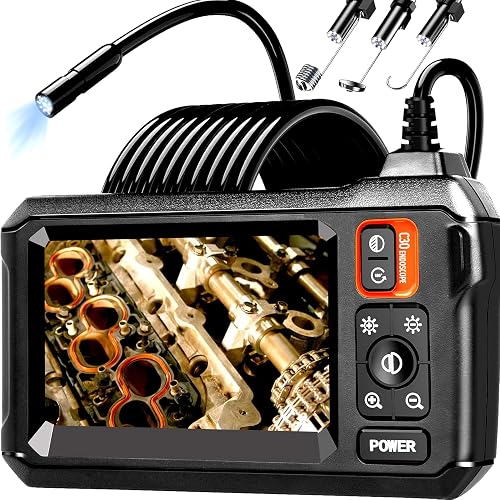
Daxiongmao Endoscope Camera with Light
9.6/10 our score
See it on Amazon -
3
- 4
 Check it
DEPSTECH 2K Endoscope Camera with Light
Best for phone-based detail - 5
 Check it
Ditomil Endoscope Camera with Light
Best for long phone inspections - 6
 Check it
Elitech Articulating Borescope with Light
Best for slim HVAC access - 7
 Check it
FOXWELL 2-Way Articulating Borescope, 1080P
Best for long recording sessions
The best borescope cameras for the money
Kinpthy is the best overall pick because it balances reach, image resolution, phone support and useful accessories. The other 6 picks each win for a more specific inspection need, including built-in screens, dual lenses, narrow probes and articulation.
We compared the stated probe sizes, cable lengths, viewing methods, lighting, articulation, recording features and included accessories. Our score weighs those features against what shoppers usually need from a borescope camera for the money.
Kinpthy Endoscope Camera with Light: Best overall value
Kinpthy Endoscope Camera with Light: Best overall value
- 1920 x 1440 resolution
- 16.4 ft semi-rigid cable
- 7.9mm probe
- iOS and Android support
Kinpthy combines a long semi-rigid cable, phone support, adjustable lighting and a high stated resolution for common home, automotive and pipe inspections.
Pros
- Long 16.4 ft cable
- Works with iOS and Android devices
- Includes hook, magnet and mirror
Cons
- Requires a compatible phone or tablet
- Single-lens design
Kinpthy is the strongest choice for a general-purpose inspection kit. Its 16.4 ft semi-rigid cable reaches farther than the articulating models here, while the 7.9mm probe remains small enough for many automotive, plumbing, wall and home inspection tasks.
The camera produces 1920 x 1440 snapshots and video. That gives you a detailed view for close inspection, while the brightness-adjustable light helps illuminate dark spaces.
The cable bends but stays semi-rigid, so you can push it forward and guide it around a passage without handling a loose wire. Its IP67 waterproof probe is rated for underwater operation up to 3.28 ft for 1 hour.
Kinpthy connects to iOS 9.0+ and Android 7+ devices through the included connectors. The phone-based design keeps the kit compact, but you need a compatible device available during the inspection.
The included magnet, hook and mirror extend its usefulness beyond viewing. The main trade-off is the single-lens design, since Acoath and DEPSTECH offer front and side viewing.
Pick Kinpthy for the broadest mix of reach and everyday inspection uses. It is the best borescope camera for the money when you want one tool for pipes, engines, wiring and household cavities.
Daxiongmao Endoscope Camera with Light: Best for simple screen viewing
Daxiongmao Endoscope Camera with Light: Best for simple screen viewing
- 4.3-inch color LCD
- 8mm camera
- 16.5 ft semi-rigid cable
- IP67 waterproof probe
Daxiongmao gives you a dedicated screen and a long cable without requiring a smartphone, app or Wi-Fi connection.
Pros
- Built-in 4.3-inch screen
- No phone connection needed
- 8 adjustable LED lights
Cons
- Cannot take pictures or videos
- Less flexible viewing than an articulating probe
Daxiongmao is the right fit when you want to inspect without connecting a phone. Its 4.3-inch color LCD shows the live image as soon as the unit powers on, so the scope works as a self-contained inspection tool.
The 16.5 ft semi-rigid cable is among the longest here. It suits drain lines, wall spaces, ducts and engine areas where the camera must travel farther than a short articulating probe can reach.
Its 8mm camera uses 8 adjustable LED lights. The stated best observation distance is 1.5–5 in, which makes close-up positioning important when you want the clearest view.
The IP67 probe is intended for wet environments, including plumbing and rain. A 3.5-hour battery provides a useful session for routine repairs and inspections.
Daxiongmao records neither pictures nor videos. That is a firm trade-off against Kinpthy, DEPSTECH and the articulating models that support saved inspection records.
Choose Daxiongmao when live viewing and simple operation matter more than documentation. It is especially useful if you want to keep your phone clean and available for other work.
Acoath Two-Way Articulating Borescope: Best for controlled angles
Acoath Two-Way Articulating Borescope: Best for controlled angles
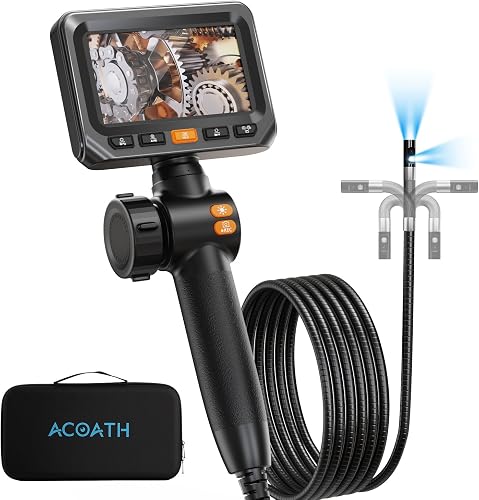
- 210° two-way articulation
- Dual front and side cameras
- 4.3-inch IPS screen
- 32GB card
Acoath suits inspections where steering the camera and switching between front and side views matter more than cable length.
Pros
- Dual-lens viewing
- Built-in screen
- Captures photos and videos
Cons
- 5 ft cable is shorter than most picks here
- Heavier at 570 g
Acoath is the best pick for inspections where the camera must turn toward a specific target. Its 210° two-way articulation provides control over the probe tip, and the front and side cameras let you switch views without rotating the cable.
The dual-lens setup covers a 70° main lens and a 60° side lens. That combination helps when a straight-ahead view misses the wall, pipe bend or component you need to examine.
A 4.3-inch IPS screen displays the image without an app or internet connection. The camera captures 1920 x 1080 photos and videos, and the included 32GB card gives the unit a place to store them.
The 5 ft semi-rigid cable is much shorter than Kinpthy, Daxiongmao, DEPSTECH and Ditomil. That makes Acoath easier to control close to the opening, but less suited to long passages.
The 0.33 in probe and IP67 rating suit wet, tight inspection areas. The unit weighs 570 g, so it is not the lightest handheld option.
Pick Acoath for steering and side views. It is the best match for pipe bends, mechanical spaces and other areas where camera direction matters more than maximum cable reach.
DEPSTECH 2K Endoscope Camera with Light: Best for phone-based detail
DEPSTECH 2K Endoscope Camera with Light: Best for phone-based detail
- 2560 x 1440 resolution
- Dual 7.9mm lenses
- 16.5 ft cable
- 2x digital zoom
DEPSTECH is the phone-based choice for buyers who want a higher stated resolution, dual lenses and app controls for saved inspection images.
Pros
- 2K resolution
- Dual-lens viewing
- Photo and video capture through the app
Cons
- Requires the DEPSTECHCAM app
- Requires a compatible phone or tablet
DEPSTECH is the phone-connected choice for buyers who want the highest stated resolution in this group. Its 2560 x 1440 image and 3.69-megapixel still resolution provide more image detail than the 1920 x 1440 phone models.
The NTC55 has front and side 7.9mm lenses. You can switch perspectives in the DEPSTECHCAM app, use 2x digital zoom and rotate the image by 90 degrees.
Its 16.5 ft semi-rigid cable provides long reach while holding its shape in a passage. The 8+1 adjustable LEDs help light dark spaces, and the IP67 probe is designed for damp or underwater use.
The camera works with iOS 11.0+ and Android 9.0+ devices through Type-C and Lightning connections. The app handles live viewing, photo capture, video capture and gallery review.
The main trade-off is the phone-based setup. Daxiongmao and Acoath give you a built-in screen, while DEPSTECH requires the compatible phone, app and OTG support for Android devices.
Choose DEPSTECH when image detail, dual-lens viewing and saved phone images are more important than a self-contained screen. For a closer comparison of viewing methods, see our guide to Wi-Fi borescope vs inspection camera.
Ditomil Endoscope Camera with Light: Best for long phone inspections
Ditomil Endoscope Camera with Light: Best for long phone inspections
- 1920 x 1440 resolution
- 16.4 ft semi-rigid cable
- 7.9mm probe
- Lightning and Micro-USB adapters
Ditomil is a practical phone-connected option with a long cable, adjustable lights and adapters for several common mobile ports.
Pros
- Long semi-rigid cable
- Includes Lightning and Micro-USB adapters
- Hook, magnet and mirror included
Cons
- Single-lens design
- Phone required for viewing
Ditomil gives phone users a long cable and a broad connector kit. The 16.4 ft semi-rigid cable works for pipes, ducts, engines and wall cavities, while the 7.9mm probe fits many small access points.
Its camera produces 1920 x 1440 images. Eight adjustable LED lights provide illumination in wet or dark spaces, and the IP67 probe is suited to damp inspection work.
Ditomil includes Type-C, Micro-USB and Lightning adapters. That makes it a flexible choice for households or work teams using different phones, although the actual viewing device remains part of the setup.
The accessory kit includes a hook, magnet, mirror and protective cap. The mirror changes the viewing angle, while the hook and magnet help retrieve small objects from tight spaces.
Ditomil uses a single lens, so it does not provide the front-and-side perspective switching found on Acoath and DEPSTECH. It also relies on a phone rather than a built-in screen.
Choose Ditomil when long reach and wide phone compatibility matter most. It fits buyers who want a straightforward inspection camera for several mobile devices and common household repairs.
Elitech Articulating Borescope with Light: Best for slim HVAC access
Elitech Articulating Borescope with Light: Best for slim HVAC access
- 6mm probe
- 180° articulation
- 4.3-inch IPS display
- 4x digital zoom
Elitech gives HVAC and mechanical users a slim articulating probe, built-in screen, recording and temperature protection.
Pros
- Thinnest probe here
- 180° articulation
- No app required
Cons
- 2.3 lb item weight
- Shorter battery life than FOXWELL's stated range
Elitech is the best choice here for narrow HVAC, automotive and mechanical access. Its 6mm probe is slimmer than the 7.9mm, 8mm and 0.24 in options, and the 180° two-way articulation helps aim the camera inside tight spaces.
The roller-style control wheel lets you steer the probe with one hand. Six adjustable LEDs illuminate dark areas, while the 90±3° field of view covers a wider internal scene.
A built-in 4.3-inch IPS display gives you live 1080P viewing without Wi-Fi, an app or phone compatibility. The unit also supports photo and video capture, 4x digital zoom, image rotation and image flipping.
The probe has a 15–100mm focal range and an IP67 rating. A temperature sensor monitors the probe and automatically shuts the unit down above 194°F (90°C), which is useful around hot mechanical spaces.
Elitech weighs 2.3 lb, making it heavier than a small phone-connected scope. Its stated battery life is up to 4 hours, shorter than FOXWELL's stated 5–7 hours.
Choose Elitech when the opening is tight and probe control matters more than a light kit. For another HVAC-focused comparison, read our guide to the best borescope for HVAC.
FOXWELL 2-Way Articulating Borescope, 1080P: Best for long recording sessions
FOXWELL 2-Way Articulating Borescope, 1080P: Best for long recording sessions
- 220° articulation
- 0.24 in probe
- 4x and 2x zoom
- 32GB storage
FOXWELL focuses on steering control, built-in storage and long stated battery life for mechanics, HVAC technicians and serious DIY work.
Pros
- 220° articulation
- 32GB storage
- No Wi-Fi or app required
Cons
- 5.3 ft cable is shorter than the long phone-connected models
- Heavier at 2.44 lb
FOXWELL suits mechanics, HVAC technicians and serious DIY users who want articulation with built-in storage. Its 220° two-way articulation gives the probe more steering range than Acoath and Elitech.
The 0.24 in probe reaches narrow spaces such as spark plug holes, ductwork and valve corners. Its 5.3 ft semi-rigid gooseneck bends and holds its position, which helps when you need to keep the camera aimed at one point.
A full-color IPS display provides live 1080P viewing. The camera includes 2x and 4x magnification, 6 adjustable LED lights, one-touch capture and 32GB storage for photos and videos.
FOXWELL states 5–7 hours of battery life. It also uses automatic heat protection that powers the unit off at 158°F, a lower temperature limit than Elitech's stated 194°F threshold.
At 2.44 lb, FOXWELL is the heaviest option here. Its cable is also much shorter than the long phone-connected models, so it is better for controlled close work than deep reach.
Pick FOXWELL for steering, storage and long recording sessions. Consider the best Klein borescope options if you are comparing this type of professional handheld format with other tool brands.
How do these borescopes compare?
The best borescope camera for the money depends on whether you value cable reach, screen independence, articulation, probe size or saved inspection records. Kinpthy leads the overall ranking, while Acoath, Elitech and FOXWELL are stronger when precise aiming is the main job.
| Product | Best for | Resolution | Cable | Probe | Our score |
|---|---|---|---|---|---|
| Kinpthy Endoscope Camera with Light | overall value | 1920 x 1440 | 16.4 ft semi-rigid | 7.9mm | 9.7 |
| Daxiongmao Endoscope Camera with Light | simple screen viewing | 16.5 ft semi-rigid | 9.6 | ||
| Acoath Two-Way Articulating Borescope | controlled angles | 5 ft semi-rigid | 9.6 | ||
| DEPSTECH 2K Endoscope Camera with Light | phone-based detail | 2560 x 1440 | 16.5 ft semi-rigid | 9.3 | |
| Ditomil Endoscope Camera with Light | long phone inspections | 1920 x 1440 | 16.4 ft semi-rigid | 7.9mm | 9.2 |
| Elitech Articulating Borescope with Light | slim HVAC access | 6mm | 8.4 | ||
| FOXWELL 2-Way Articulating Borescope, 1080P | long recording sessions | 5.3 ft semi-rigid gooseneck | 8.0 |
The long-cable phone models are Kinpthy, DEPSTECH and Ditomil. Each reaches 16.4–16.5 ft, which is useful for pipes, walls and ducts.
Kinpthy uses a single lens, while DEPSTECH adds dual lenses and a higher 2K image.
Daxiongmao also reaches 16.5 ft, but its main advantage is the built-in display. It gives live viewing without a phone and is the simplest pick for basic inspections.
Its stated limitation is that it cannot capture photos or videos.
Acoath, Elitech and FOXWELL trade cable length for probe control. Acoath has a 5 ft cable and 210° articulation, Elitech has a 6mm probe and 180° articulation, and FOXWELL has a 5.3 ft cable with 220° articulation.
For a narrow opening, Elitech has the smallest stated probe at 6mm. For dual-lens viewing, Acoath and DEPSTECH are the strongest choices.
For storage without an app, Acoath, Elitech and FOXWELL include recording features.
What should you look for in a borescope camera?
Start with the opening size, then choose the viewing method and cable length that match the inspection. A camera with more resolution cannot enter an opening that is too small, and a long cable does not replace articulation when the target sits around a bend.
Probe diameter
Probe diameter controls where the camera can go. Elitech's 6mm probe is the narrowest in this group, followed by the 7.9mm Kinpthy, DEPSTECH and Ditomil probes.
Daxiongmao uses an 8mm camera. Acoath's probe is 0.33 in, while FOXWELL's is 0.24 in.
Convert the stated measurement against the access hole before choosing a scope for a fixed opening.
Cable length
A 16.4–16.5 ft cable gives more reach inside pipes, ducts and wall cavities. Kinpthy, Daxiongmao, DEPSTECH and Ditomil are the long-reach choices.
Articulating models use shorter cables because their main advantage is control near the opening. Acoath has 5 ft, FOXWELL has 5.3 ft and Elitech's data emphasizes its slim articulated probe.
Do you need a screen or a phone connection?
Choose a built-in screen for quick, self-contained inspections. Choose a phone connection when you want a compact kit, app controls or easy access to saved images on your mobile device.
Built-in screen
Daxiongmao, Acoath, Elitech and FOXWELL include screens. These models keep live viewing on the inspection unit, which helps when your phone is needed for calls, notes or other work.
Acoath, Elitech and FOXWELL also capture photos or videos. Daxiongmao focuses on live viewing, so it is the better choice when you only need to see the problem and do not need a saved record.
Phone-connected viewing
Kinpthy, DEPSTECH and Ditomil use a phone or tablet. DEPSTECH requires the DEPSTECHCAM app, while Kinpthy and Ditomil use phone connections with their included adapters.
Phone models are often easier to carry and share between jobs. Their trade-off is that the phone, port and app become part of the inspection setup.
Is articulation worth paying for?
Articulation is worth choosing when the camera must point around a corner or toward a side wall. It matters less for a straight pipe or cavity where the main requirement is cable reach.
Two-way articulation
Acoath offers 210° articulation and front-and-side camera switching. FOXWELL offers 220° articulation, while Elitech provides 180° two-way articulation with a 6mm probe.
The wider steering range helps you aim without repeatedly pulling the camera back. It does not make a short cable long, so match articulation with the distance to the target.
Dual-lens viewing
Acoath and DEPSTECH use front and side cameras. The side view helps inspect a wall, pipe edge or component beside the cable's path.
A dual-lens camera is different from articulation. DEPSTECH has dual lenses with a long cable but is phone-based, while Acoath combines dual lenses, a screen and articulation.
Which borescope is best for plumbing and pipe work?
Kinpthy is the best general plumbing choice because its 16.4 ft cable, 7.9mm probe, adjustable light and waterproof design cover long, dark passages. Choose Acoath for pipe bends where controlled aiming matters more than cable length.
Daxiongmao is useful when you want a screen and a long cable without a phone. DEPSTECH adds a side lens for phone users who need a broader view, while Ditomil includes a mirror, hook and magnet for basic retrieval and inspection work.
Keep the cable semi-rigid as you guide it forward. The cable needs enough shape to push through a passage, but forcing it against a hard obstruction can make the camera difficult to control.
Which borescope is best for HVAC and automotive work?
Elitech is the strongest HVAC and automotive pick because its 6mm probe, 180° articulation, built-in screen and temperature protection suit tight mechanical spaces. Choose FOXWELL for a similar screen-based workflow with 220° articulation and longer stated battery life.
Acoath also fits HVAC and automotive inspections with its dual lenses and 210° articulation. Kinpthy and Ditomil work well for longer straight runs, while DEPSTECH adds dual-lens phone viewing and 2x digital zoom.
For engine areas, probe diameter and heat conditions matter first. Elitech includes automatic shutdown above 194°F (90°C), and FOXWELL lists automatic protection at 158°F.
How should you use and care for a borescope?
Use the smallest suitable probe, begin with the light level low enough to limit glare, and guide the cable without forcing it. Wipe the probe after wet or dirty work and keep the lens clear before storing the camera.
Before the inspection
Charge a screen-based model or prepare the compatible phone and app for a phone-connected scope. Attach the hook, magnet or mirror only when the task calls for it, and keep the protective cap available when the accessory is removed.
For a pipe or wall inspection, plan where the cable will enter and where the display will sit. A long cable gives reach, but a clear path helps you control the probe and avoid sharp bends.
During the inspection
Adjust the LEDs gradually so the image shows surface detail without excessive glare. Move the probe slowly and pause when the image changes, since a short movement can pass the area you need to inspect.
Use the side lens on Acoath or DEPSTECH when the problem sits beside the cable path. Use articulation on Acoath, Elitech or FOXWELL when you need to aim the camera rather than simply move it forward.
After wet or dirty work
Remove debris from the probe and dry the accessible camera parts before storage. IP67 applies to the stated probe design, so keep the handheld display, phone connection and charging areas away from water.
Save useful photos or videos before the next job. Acoath, Elitech, FOXWELL and the phone-connected models support documentation, while Daxiongmao is intended for live viewing.
Verdict: which is the best borescope camera for the money?
The Kinpthy Endoscope Camera with Light is the best borescope camera for the money overall. Its 16.4 ft semi-rigid cable, 7.9mm probe, 1920 x 1440 image, phone support and accessory kit give it the most balanced fit for everyday inspections.
Choose Daxiongmao for a built-in screen and live viewing without a phone. Pick Acoath for dual-lens steering around bends, DEPSTECH for higher-resolution phone detail, or Ditomil for long reach with several phone adapters.
For narrow HVAC and automotive spaces, Elitech is the focused choice because of its 6mm probe and articulation. FOXWELL suits longer recording sessions when you want 220° articulation, built-in storage and no app.
The right value comes from matching the tool to the inspection. Pick the long-cable Kinpthy for general use, a screen model for simple field viewing, or an articulating scope when camera direction matters more than reach.
Our top 3 picks at a glance
-
1
-
2
Best for simple screen viewing
Daxiongmao Endoscope Camera with Light
9.6/10 our score
See it on Amazon -
3
Frequently asked questions
Is a phone borescope better than one with a screen?
A phone borescope is better when you want app-based viewing, image capture and a long cable. A screen model is better when you want a ready-to-use tool that does not depend on a phone, app or wireless connection.
What probe size is best for tight inspections?
A 6mm probe gives you the narrowest access among these picks. The 7.9mm, 8mm and 0.24 in options also fit many automotive, plumbing, wall and HVAC inspection jobs, but the opening still determines which camera can enter.
Do borescopes work underwater?
Several picks have an IP67 waterproof probe, including Kinpthy, Daxiongmao, Acoath, DEPSTECH, Ditomil, Elitech and FOXWELL. Use the waterproof rating for the probe and follow the intended inspection conditions rather than treating the entire handheld unit as waterproof.
Do articulating borescopes record inspection images?
Acoath, Elitech and FOXWELL include photo or video recording features. Daxiongmao is the exception here because its stated design provides live viewing but cannot take pictures or videos.
How long should a borescope cable be?
Choose a 16.4–16.5 ft cable for long pipes, wall cavities and extended reach. A 5–5.3 ft articulating scope is easier to control when the inspection is close and the main challenge is aiming the camera around an obstruction.


