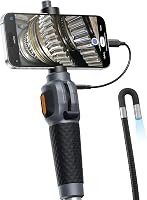
How Much Does a Borescope Cost?
A borescope costs anywhere from budget-level to premium depending on the screen, resolution and cable length. Most people shopping for a how much is a borescope answer end up in the mid-range, where a screen unit or a 2K phone camera gives the clearest view for the money.
On this page (7 sections)
- What drives the price of a borescope?
- What does a budget borescope get you?
- What does the mid-range add?
- What does a premium phone borescope cost, and what do you get?
- When is a trade-grade borescope worth the extra cost?
- How does cable length and camera size affect what you pay?
- Which borescope fits your budget and your job?
A borescope costs anywhere from budget-level to premium depending on the screen, resolution and cable length. Most people asking how much is a borescope end up in the mid-range, where a screen unit or a 2K phone camera gives the clearest view for the money.
Price tiers matter more than a single number. The cheapest probes work, but a slightly higher tier adds a screen you can read in daylight or a sharper lens for small engine work.
This guide breaks down what each tier buys so you can match the tool to your job.
What drives the price of a borescope?
The screen, resolution, cable and ruggedness set the price, not the brand name alone. A borescope is a camera on a flexible cable, and each part adds cost.
A built-in LCD screen removes the need for a phone. That convenience pushes a model into a higher tier than a plug-in probe.
Resolution is the next big lever: a 1080P lens costs less than a 2K dual-lens camera with front and side views.
Cable length and stiffness also matter. A 16.5 ft semi-rigid cable costs more than a short flexible one, and it holds its shape in a pipe or wall cavity.
Waterproofing adds cost too, since an IP67 probe needs sealed connectors and a water-safe housing.
Trade-grade kits add rechargeable batteries, SD storage and 360 image rotation. Those features suit daily professional use, not a weekend DIY check.
What does a budget borescope get you?
A budget borescope gives you a working camera and light for simple checks. It suits a homeowner who needs to peek behind a wall or into a spark plug hole once or twice.
At this tier you usually get a fixed-focus lens, a handful of LEDs and a short-to-medium cable. The image is clear enough to spot a blockage or a loose fitting, but it won't match a 2K sensor for detail.
Budget models often skip the screen and plug into a phone or a computer. That keeps the cost down but means you supply the display.
If your phone is your main camera, this is a sensible trade.
Waterproofing is the spec to watch here. A probe rated IP67 handles wet plumbing and rain, while an unrated probe should stay dry.
Check the camera diameter too, since an 8mm head fits tighter spaces than a 10mm one.
What does the mid-range add?
The mid-range adds a built-in screen or sharper resolution, which is where most buyers land. You get a display you can read without squinting at a phone in bright light.
The Daxiongmao Endoscope Camera with Light is a good example of the mid-range screen tier. It has a 4.3-inch color LCD screen, so you view images in real time without connecting to Wi-Fi or installing driver software.
That means no risk of dirtying your phone on a job.
Its 8 LED lights keep the image clear in dark spots, and the 8mm camera head passes through a spark plug hole to inspect a combustion chamber. The cable is both stiff and flexible, which helps in walls and vents.
It's rated IP67 for wet work.
One detail to know: this model cannot take pictures or videos. If you need to save findings for a report or a client, look for a model that records.
For a plain look-and-see job, the screen alone is the reason to pay more than budget.
Who should pick the Daxiongmao?
Pick the Daxiongmao if you want a screen you can use straight out of the box and don't need photo or video capture. It suits home inspections, HVAC checks and engine peeks where you just need to see.
Skip it if recording matters, or if you already carry a phone with a good screen and prefer a lighter probe. A phone model saves the bulk of a separate display.
What does a premium phone borescope cost, and what do you get?
A premium phone borescope costs more than a budget probe because of resolution and dual lenses. You pay for a sharper sensor and the ability to see around corners.
The DEPSTECH 2K Endoscope Camera with Light is the top of the phone tier here. It has a 2560x1440P dual-lens camera with front and side views for a 360 look.
The 2K lens is sharper than standard 1080P, so fine detail shows up in the image.
It plugs into an iPhone or Android phone with the included Type C connector and Lightning adapter. The app handles photo and video capture, 2x zoom and 90 degree rotation.
The 8 plus 1 LEDs and IP67 rating make it useful in dark, damp spots like drains and sewers.
The trade-off is that it runs only through the DEPSTECHCAM app and needs OTG support on Android. If your phone lacks OTG, this model won't work for you.
For a phone-first buyer who wants detail, it's the strongest camera in this group.
Who should pick the DEPSTECH?
Choose the DEPSTECH if you want 2K detail and dual lenses and don't mind using your phone as the screen. It suits buyers who record findings and want to switch between front and side views in tight spaces.
Skip it if you need a standalone screen or your Android phone doesn't support OTG. In that case, a screen unit like the Daxiongmao is the simpler buy.
When is a trade-grade borescope worth the extra cost?
A trade-grade borescope is worth it when you inspect all day and need a screen plus recording. The extra cost buys durability and features that save time on repeated jobs.
The Milwaukee M12 M-Spector 360 Inspection Camera is the trade-tier pick. It has a 4.3-inch LCD screen and 720p camera, with 360 image rotation you adjust by rotating the screen or pressing a button.
Three levels of zoom and five brightness modes help you focus on details.
The 10mm head fits a 3/8 inch hole, and the cable balances flexibility and rigidity for drain lines and behind-wall checks. It captures images and videos and includes an SD card for sharing findings.
That recording and the rugged build are what separate it from the mid-range.
It ranks last on resolution here because 720p video and 0.92MP stills trail the 2K DEPSTECH on resolution. For a plumber or inspector who needs a durable screen unit and saves reports, the Milwaukee earns its keep.
For occasional use, the Daxiongmao or DEPSTECH gives more image detail per dollar.
Who should pick the Milwaukee?
Pick the Milwaukee if you inspect for a living and want a tough kit with a screen, zoom and SD storage. It suits drain line, wall cavity and maintenance checks where you document what you find.
Skip it if resolution is your top priority or you only check a pipe once a year. A cheaper phone or screen model will show you the blockage without the trade-grade price.
How does cable length and camera size affect what you pay?
Longer cables and smaller camera heads cost more, so decide your reach and clearance before you buy. A 16.5 ft cable handles most wall, vent and drain jobs in a house.
A short cable limits you to close work and costs less. If you inspect long sewer runs or deep wall cavities, a longer semi-rigid cable is worth the step up.
Semi-rigid cable holds a bend so you can steer the camera around a corner.
Camera diameter follows the same logic. An 8mm head fits spark plug holes and narrow pipes, while a 10mm head covers more area but won't pass the tightest gaps.
The Daxiongmao and DEPSTECH both use a slim 8mm or 7.9mm head; the Milwaukee uses a 10mm head for broader coverage.
Waterproofing rounds out the cost. An IP67 probe handles wet plumbing and outdoor rain, and that seal is part of why a plumbing-focused model costs more than a dry-use probe.
Which borescope fits your budget and your job?
Match the price tier to how often you inspect and what you need to see. For most people asking how much is a borescope costs to plan for, the answer is the mid-range: a screen unit or a 2K phone camera covers everyday checks well.
Pick the Daxiongmao for a standalone screen and no-phone simplicity. Pick the DEPSTECH for 2K detail and dual lenses if your phone supports the app.
Pick the Milwaukee when you need a trade-grade kit that records to an SD card.
Before you order, measure the gap you need to reach and note your phone type if you go the phone route. If your job is HVAC-specific, our guide to the best borescope for HVAC narrows the field.
For a Klein-focused comparison, see the Klein ET17 vs ET19 breakdown and the roundup of the best Klein Tools borescopes. If your work is plumbing rather than inspection, how much is a sewer camera covers the next tier up in reach and cost.
The price you pay should follow the job. A budget probe for a one-time wall check, a mid-range camera for regular home and HVAC work, and a trade kit only when you document findings for a living.
That's how to spend on a borescope without overbuying.
Frequently asked questions
How much is a borescope for home use?
A basic home borescope sits in the budget tier, while a screen model with a 4.3 inch LCD lands in the mid-range. Home users rarely need a trade-grade kit, so the budget and mid-range tiers cover most wall, vent and plumbing checks.
Why do some borescopes cost more than others?
Price tracks the screen, resolution, cable length and ruggedness. A 2K dual-lens phone camera costs more than a plain 1080P probe, and a kit with a rechargeable handle and SD storage costs more than a plug-in model.
Do I need an expensive borescope for HVAC work?
No. Many HVAC checks only need a waterproof probe and adjustable LEDs, which budget and mid-range models supply.
A trade-grade camera is worth it when you inspect all day and want a built-in screen and recording.
Is a cheap borescope good enough for a drain pipe?
A budget model with an IP67 probe and a semi-rigid cable can handle a short drain check. For longer runs or frequent plumbing work, a longer cable and a brighter screen make the mid-range worth the extra cost.
What should I check before buying a borescope?
Check the screen or phone compatibility, the camera diameter, the cable length and the waterproof rating. These four specs decide whether the tool fits your job, and they matter more than the price tag alone.